Showing posts with label random. Show all posts

Stillness at the Super Bowl Half-Time Show

I found myself reflecting on the Super Bowl this morning and wondering when the Half-Time Show became a part of the entire event. Because I like to look into such things, here's a brief history of the event:

In 1993, the NFL decided it would, for the first time in its history, have only one person perform during the Half-Time show of the Super Bowl. Due to his increasing popularity around the world, they chose Michael Jackson. Little did they expect that, for the first time in the history of the game, the viewing audience would actually increase during the Half-Time show. This set a precedent that has been followed ever since, with each band or performer attempting to capture and draw in viewers during the game break.

I watched Michael Jackson's performance when it happened and I just watched it again:

There's so much that I could discuss about this performance, but I want to point out a few things that I find absolutely incredible about the opening 2 minutes.

- To start it off, Jackson does what, to my limited knowledge, had never been done before - utilizing the two mega screens as an integral part of his entrance.
- He used these two screens and two decoy performers to tease the crowd for the first 32 seconds of the show. Using the decoys at the opening only further built up the anticipation of his arrival and performance.
- Jackson is launched up through the smoke onto stage at the 34 second mark and adopts the "Dangerous" pose. There is no music. There is no light show. It is just him standing there. Jackson makes it a point to prove that he is the show. For an absolutely astonishing seventy-four seconds, Jackson does not move. He is still. The crowd grows anxious and I am certain that the organizers of the event were not feeling quite as confident in their choice at this point.
- Then he turns his head to the left in one quick motion. He holds this pose for sixteen seconds. That brings his total time on stage as a statue to exactly a minute and a half. Not a beat of music has played. Jackson hasn't said or sang a single word and yet the crowd is growing in its intensity.
-  Finally, at just over two minutes into the performance, the music starts and Jackson become animated. The crowd goes wild. Before he has even begun, Jackson has given the attendees a memorable experience.

For those of you who have never been on stage in front of a group of people (large or small), every second that goes by silently can seem like an eternity. To hold a pose for a few seconds can be a challenge. To let a line linger for a moment after it is spoken for effect takes a certain will that some people cannot master. How Jackson could stand as still as he did for as long as he did in that moment is totally beyond me. Here he was on the biggest stage in the world, in front of the largest crowd in the world, to perform a show that had been hyped through the media for months leading up to this moment, and he just stands there stiff as a board. I'm sure his adrenaline was cranked and that he was excited to deliver an amazing once-in-a-lifetime performance, but he chose to stand still to start it all off.

In today's environment, Jackson's stillness would have cost the broadcasters $15,000,000 in airtime. And yet, would the performance have been as memorable if he hadn't started it that way? I doubt it. The still, slow beginning made it that much more memorable.

Reflecting on other Super Bowl performances, there are few moments that I can think of with any great amount of clarity. The Jackson/Timberlake "wardrobe malfunction" in 2004 doesn't really count as the memory is linked to the activity at the end as opposed to the performances themselves. I think the 2007 performance by Prince was pretty entertaining, but I understand that many people don't like him or his music all that much - even though his musicianship is hard to be topped by anyone. Some people will say "But what about Paul McCartney in 2005?!??" I understand that people love the music, and Sir Paul did a fine job, but I wouldn't say it was memorable from a "Wow!" perspective.

I'll leave you with what I think is the best performance during the Super Bowl Half-time show since Michael Jackson broke the mold in 1993. It's a superb performance that is very entertaining and incredibly memorable, as U2 rocked the Superdome in 2002 and then brought everyone to tears with their tribute to 9/11 victims:
 
For your reference, here's a complete list of Super Bowl Half-Time Shows.

Three Disciples and a Stooge

A couple of nights ago, according to our nightly bedtime routine for the girls, we were reading the story of when Jesus called the first disciples in Luke 5. You'll recall that Jesus climbs into Peter's boat and tells the men to catch some fish by casting in a certain area. Peter explains the fruitless time they had already spent that morning not catching any fish and yet declares "at your word I will let down the nets." After doing so, they catch so many fish that they need help to haul it in. This event leads to Peter, James and John leaving their boats and becoming the first disciples of Jesus Christ.

At the end of the story, we reviewed it by asking the girls a couple of questions.
One of the questions was "Who decided to stop fishing and follow Jesus?"
Lydia responded "Peter... John... and... Curly!"

The Calling of Three Disciples and a Stooge

 I could immediately hear Curly Howard responding to Jesus request to lower the nets: "Soitenly!"

Is it Miserable Outside? Perspective Matters

I read the following Wednesday evening, prior to our thermometer going triple digits.
Things have been much worse around St. Louis.
"In June, the weather in St. Louis often turns into a blast furnace that lasts until mid September. That year (1934), on schedule, the grass in Sportsman's Park faded to a well-baked brown. Adding to the misery ushered in by the miles-long dust cloud in mid May, the Midwest was now caught in the grip of a heat wave that would last all summer and kill more than a thousand people. A two-year drought caused the Mississippi River to continue to drop and thus led to Missouri's worst farm crisis ever. St. Louis was also registering the highest temperatures since 1871. For thirty consecutive days, the thermometer reached 100 degrees or more."
- from "The Gashouse Gang " by John Heidenry, pp138-139

What Kind of Shower?

I woke up feeling really groggy this morning.
Lydia and Lainey were getting ready to eat breakfast and Lisa was getting ready to go out for a run, when I said "I am going to take the world's longest shower". Prior to heading toward the bathroom, I joined the girls at the table to pray at breakfast time.

Lydia agreed to pray for us and this was her prayer:
"Dear Jesus, thank you that Mommy's running, Daddy's taking the worst shower and for our food. Amen."

As it turns out, my shower was neither what I had stated nor what Lydia had stated.

But it was better than this poor kids shower:

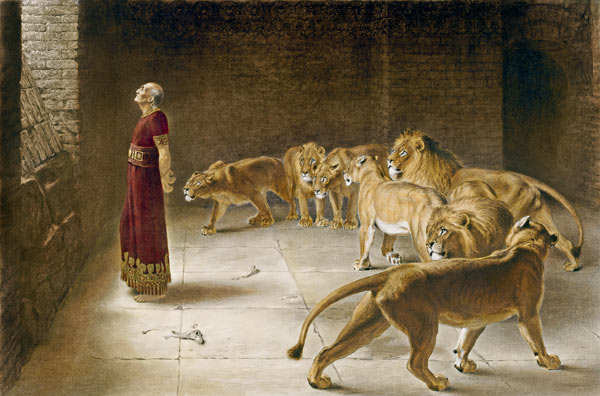
A Poem About Daniel and the Lions

When Daniel was thrown into the den
Was he confident in Your plan for him?
Did his heart race fast with unchecked fear?
"Daniel's Answer to the King" by Briton Rivier
Did his eyes fill up with questioning tears?

Did he pray silently to You?
Was he afraid to make a move?
At what point did his fear subside?
When was he comfortable inside?

Did the lions nuzzle up to him in that place?
Did they sniff him out, breathe on his face?
Did they wander around in that place unbothered?
Did their ears perk up as he called to you Father?

When the king came calling, did the lions arise?
When he shouted his greeting, was there hope in his eyes?
When the response came, did his heart soar?
Was the moment punctuated with a lion's roar?

Daniel - servant, prophet, faithful
Lions - creatures, passive, powerful
King - tricked, trapped, released
A wonderful story of God, man and beast.

- Written 07MAY12

I encourage you to read the entire account of Daniel and the lions.

The Marriage Commitment Reflects the Depth of Love

In contrast to how the world defines love and the importance of marriage:

"But when the Bible speaks of love, it measures it primarily not by how much you want to receive but by how much you are willing to give yourself to someone. How much are you willing to lose for the sake of this person? How much of your freedom are you willing to forsake? How much of your precious time, emotion, and resources are your willing to invest in this person? And for that, the marriage vow is not just helpful but it is even a test. In so many cases, when one person says to another, "I love you, but let's not ruin it by getting married," that person really means, "I don't love you enough to close off all my options. I don't love you enough to give myself to you that thoroughly." To say, "I don't need a piece of paper to love you," is basically to say "My love for you has not reached the marriage level."  - Tim Keller "The Meaning of Marriage", p78

Albert Pujols - The Choice

On January 6, 2012, I posted this status update:
Albert Pujols is a generous man. I pray that God uses him powerfully in California, as He is still doing in St. Louis.
My sentiments toward that end have not changed. However, reading the following from Albert today kind of altered how I view him:
Pujols says his preference was to stay a Cardinal for the rest of his career, envisioning the day he would be revered in the city, just as Stan Musial, Bob Gibson, Lou Brock and Red Schoendienst were. He would have his number retired and have a statue erected outside Busch Stadium along with the other greats.   (Source: USA Today)
Albert Pujols Homerun off Brad Lidge -  2005 NLCS
Albert Pujols was already revered in St. Louis. He was a living legend, with nothing but further respect and support to gain as the years ticked passed towards his retirement. He could have coasted into the Hall of Fame on his first ballot, wearing the Cardinals hat that gave him a chance to play, prove himself and become one of the best players in history. He could have spent his entire career with the organization and town that held their breath every time he winced or appeared even slightly injured. He could have been the shining example of how a player can stick with a club that may not be the most glamorous, or have the largest payroll, but is dedicated to winning and representing their city and fans well.

So much could have been different.

I'm not saying that Albert Pujols should have turned down the Angels offer. He is a professional athlete and if he wants to maximize his earning based on his abilities and skills, then more power to him. He has every right to make the decision he made. I'm praying that God uses him to dramatically impact his new hometown.

I don't think the Cardinals should have paid him anything near that contract. It wasn't in the organization's best interest long-term. Did they want Albert to retire a Cardinal? You bet. Could they compete with the big money that was thrown at him from the West Coast? Absolutely not.

Sometimes the numbers just don't compare well, and it appears that this is one of those instances where the disparity between dollars and years in the contract offered were apparently too large to overcome for a smaller ball club. The Cardinals made their stand. The Angels made their offer. Albert made his choice.

And I guess that is what bothers me about this statement in this article. St. Louis did not drive Albert Pujols away. The Cardinals didn't ride him out of town on a rail. It's not as if the extremely loyal fan base of the St. Louis Cardinals collectively removed their numerous Pujols jerseys, set fire to them at first base in Busch Stadium and then march down to the Mississippi River and chucked them in.

Stan Musial's Christmas WishI'm pretty sure that Bob Gibson, Lou Brock and Red Schoendienst, along with numerous other former Cardinals all wanted to see Albert remain a Cardinal. In fact, Stan Musial, the man that is, according to Albert Pujols, the only player worthy to be called "The Man" went to the internet to do his part to get Albert to stay in St. Louis.
If Albert Pujols wanted to remain a Cardinal for life, he could have made that happen.
If Albert wanted a statue next to the greats of Cardinal nation, he could have made that happen.
If Albert wanted to see his number 5 retired at Busch Stadium, he just had to keep playing ball.
If Albert wanted to be revered as a Cardinal, then all he had to do was stay in town.

But he didn't choose that for himself.
It was all right there for the taking.

If that was his dream, if that was his hope, then I'm afraid he gave it up for some numbers that the dedicated, hard working, baseball loving, intelligent St. Louis Cardinal fans recognize as detrimental to the team's future.

Albert made his choice. Now he has to work really hard at making that dream happen over the waning years of his career as an Angel. Something tells me that the people of California may have other stars to follow when Albert's productivity starts to decline.

I wish him well, but I wish he would stop talking about how desperately he dreamed of staying a Cardinal for life. You had that choice Albert, and you chose to move on.

And now, so shall we.

Using Idle Time For Good


The first part of this TED talk surprised me.
It's amazing to think that some of the reCaptchas I have filled in have helped digitize books.
To know that information is not only captured from print media and stored for future reference in a different format is great, but the fact that everyday people are participating in that effort unknowingly is amazing.

Oh, and someday I hope to learn Spanish while translating the web.

Why I Run / When I Run

Today I am sore.
Why?
Because yesterday I ran.

I didn't run from the police.
I didn't run to evade getting tackled by a large man in a helmet.
I didn't run up and down a court to throw a ball in a basket or back and forth across a pitch to kick a ball in a goal.
I didn't run as a part of any team sport.

While all of these things would definitely wear me out, they had nothing to do with my running.

Questions About the KONY 2012 Campaign

A couple of brief thoughts on the KONY 2012 campaign:


- If people (myself included) proclaimed the Gospel as vocally as they promote a viral campaign, it would truly change the world.

- Social awareness may grow through social media, but it doesn't change the situation unless people actually put hands and feet to the problem.

- A well produced video can create a lot of noise on the web, but can it really bring about change?

- If an organization is willing to promote certain things as fact in such a way that is misleading, do you really want to give them your money?

- What happens if all these people donate to the charity and later find out that their money never impacted the life of a child in Uganda/Africa/anywhere?

- It is appropriate and responsible to question the motives behind such a movement and to use the past history of that organization to determine your involvement in promoting or donating to an organization.


If you want to help children in Africa, there are plenty of ways through various charities that are more efficient at getting the money to impact children, more transparent in their operation and more Bible-based in their approach.

A few charities worth considering:
WorldVision
Compassion International
Save the Children
Blood Water Mission


If you want to know why I think some of these things, do some research. Below are a few articles I found helpful.

Challies: KONY 2012

KONY 2012: A Survivor's Perspective

Kony 2012: Why I’m Opposed To The Campaign

Joseph Kony is not in Uganda (and other complicated things)

On KONY 2012: I wanted to stay as far away as possible...


The REDDIT comments are quite intriguing


The Cosmological Theory Questioned

Here's an example of when science does not discover what it expects to discover and scrambles:

Scientists cannot find many of the galazies that should exist around the Milky Way galaxy.
According to cosmological theory, says MIT astrophysicist Simona Vegetti, "there should be thousands of dwarf galaxies in the Local Group." That's because the earliest days of the cosmos were not a tidy time, and after the big galaxies came into being a lot of debris ought to have been left behind — "debris," in this case, meaning little galaxies, made partly of what's known as cold dark matter. The fact that we don't see the galaxies, she says, is due to one of three things: Either they're simply too faint to detect, or there's something unusual about the local cosmic neighborhood that would explain why it departs from the larger rule. Or — and this is the troubling alternative — maybe the theory itself, which has been generally accepted for the past 30 years or so, is fundamentally wrong in some way. 
So what does this mean?
The cosmological theory may be fundamentally wrong - as in, incorrect.  

The presented alternatives as to why these galaxies are missing are as follows, with my response:
1. These galaxies are just to faint to detect.  It is hard to believe that some of our closest neighbors would be invisible to the technology that allows us to peer across billions of light years to incredibly distant galaxies.
2. Our galaxy doesn't follow the cosmological rules for some reason. It seems difficult to accept that there may be some mysterious reason why our galaxy might not have behaved as every other galaxy is expected to during its creation.
3. The theory is fundamentally wrong in some way. I think this means that scientists are discovering that they cannot prove one of the fundamental things that should exist if the Big Bang did indeed form our galaxy. They aren't willing to state that they believe the theory is incorrect at this point, just that it may be flawed.

Here are a few unanswered questions that I have after reading this brief article:
1. Have the expected "debris" been seen in other galaxy neighborhoods? If not, then why is this theory even proposed? Does the theory itself exist strictly on the basis that the Big Bang would have had to result in such "debris" existing?

2. If "debris" has been documented elsewhere, were those galaxy neighborhoods larger or smaller in size when compared to the Milky Way? If the answer is yes and the neighborhood is larger than the Milky Way galaxy, then it leads me to alternative #2 above, which naturally points us to alternative #3. If the answer is yes and the neighborhood is smaller, then I fail tun understand why we cannot find our own "debris" and dismiss alternative #1 to land at #3, after a brief time at alternative #2. If the answer is no, then it leads me directly to alternative #3.

From my own personal Christian perspective, I believe that this leads me to the alternative not mentioned, which is that God made it all and placed it all exactly where He wanted it to be. Perhaps the reason they cannot find the "debris", which resulted from quickly moving masses colliding with one another to form galaxies over time, is because it didn't happen that way. Perhaps these galaxies were created in space as they are by a God who wanted to display His magnificence and splendor on a canvas that is wider than mankind ever imagined was even in existence.


"Thus the heavens and the earth were finished..." - Genesis 2:1

"When I look at your heavens, the work of your fingers, the moon and the stars, which you have set in place, what is man that you are mindful of him, and the son of man that you care for him?" - Psalm 8:3-4

We Meet to Meet

"When an organization has more of its decisions made by committees, that gives more influence to those who have more time available to attend committee meetings and to drag out each meeting longer. In other words, it reduces the influence of those who have work to do, and are doing it, while making those who are less productive more influential." - Thomas Sowell

I have found this to be incredibly true.

If you look around your company, you can probably identify several people who seem to be on all sorts of project teams or committees or groups or whatever they may be called at your place of employment.

The natural response to recognizing this fact is usually "How do they have time for all of that?".

The answer to that question is quite simple: they either don't have enough work to do or they don't do the work they are supposed to do, usually pushing it off onto other people.

The sad thing is that managers love to see people who are "great team members" running from meeting to meeting to meeting and are so busy. Although they might never accomplish a single thing of significant value, the effort and time involved in those meetings is valued far greater than the value of the person with his head down in the cubicle cranking out work that adds to the bottom line of the company. In fact, more often times than not, the person in the cube is also carrying the workload of the meeting monster next door.

It's a shame that managers who love to meet for the sake of meeting breed people who meet for the same reason. Meetings do not get work done. While it is useful to pull groups together from time to time to strategize how the workload will get completed, most meetings that are on the schedules of many employees are not helpful and add little, if any, value to the bottom line of the company.

So managers - Kill the meetings and get back to allowing your employees to do some real work. Hold your employees equally accountable for the work that they are accomplishing, not the work they are talking about doing someday.

That is what the employee in the cubicle would love to tell you.

God's Praise is Unstoppable

"Sometime praise is impossible to contain. It is a violently full river for which there is no dam high enough or wide enough to contain it. He will be on the tip of our tongue. He will spill out."
- David Crowder (Praise Habit, p53)

Specific Socks

Gold Toe Men's Cotton Quarter Athletic Sock, White, 3-Pack, 10-13Today at lunch, my sister and I got into a disagreement surrounding socks.
Here are the points of contention:

She thinks it is weird that some people think that certain socks go on certain feet.
I know that each sock has a specific foot that it calls home.

She claims that every sock is made the same and that they fit each foot the same.
I agree with both of these statements until after a sock is worn a few times.

She claims that a sock returns to its original shape after being washed.
I say that a sock will never return to it original shape, as it will always get stretched to fit the foot it belongs to.

In a bried survey of coworkers who were present during this debate, I believe I proved my point by having both people questioned agree with my stance.

Does anyone agree with me that socks belong to a certain foot, or would you agree with my sister that all socks are to be worn on either foot at any time?

(And yes, I wear Gold Toe Socks and love them.)